The James McNeill Whistler exhibition at Tate Britain is big, probably a bit too big, but it's packed with beautiful pictures and it's not in the least bit boring. That's not surprising as Whistler led a colourful life, never shying from controversy and confrontation -- notably pursuing a high-profile libel case against John Ruskin -- and he produced art that was groundbreaking, hugely influential and enormously atmospheric. Including, of course, probably one of the most recognisable paintings in art history, that of his mother in profile, dressed in black. It's in this show, and we'll be taking a look at it shortly. But we start in Whistler's studio, where the artist has painted himself at work, palette and brush in his hands, and looking out directly at us, the viewers. This is the first picture you see in the show, and we're told that for Whistler, the studio was a place for public performance, as well as making art. So here he is, making a statemen...

Cleopatra, David and Goliath, Judith and Holofernes. Drama, emotion, colour. Agony and ecstasy. It's all there in Artemisia: Heroine of Art at the Musée Jacquemart-André in Paris. Except they haven't got the space to do it justice. Because if we're going back in art herstory, there's really no bigger name than Artemisia Gentileschi.
This heroine of art draws big crowds, and her often quite sizeable canvases deserve a large stage on which to be properly appreciated. But there's next to no space in the Musée Jacquemart-André, which has some of the most cramped and crowded exhibition rooms we've been to anywhere in Europe. It's a bit like watching City play United -- or perhaps in this case Roma against Napoli -- in your back garden.
But that's enough whinging about the venue -- for a paragraph or two, at least -- because the art is spectacular. Artemisia Gentileschi was a prodigy, creating masterful -- mistressful? -- canvases at quite a young age. In an era when women couldn't go out and learn a trade, when women artists couldn't study at an academy, she trained in the workshop in Rome of her father, Orazio, copying, and soon outdoing, his work.
There's a painting here by Orazio made in 1612 of the Biblical story of Judith. Hung beside it, from three years later, is Artemisia's version; the composition is very similar, but hers seems to have so much more depth, more finesse, more realism to it.
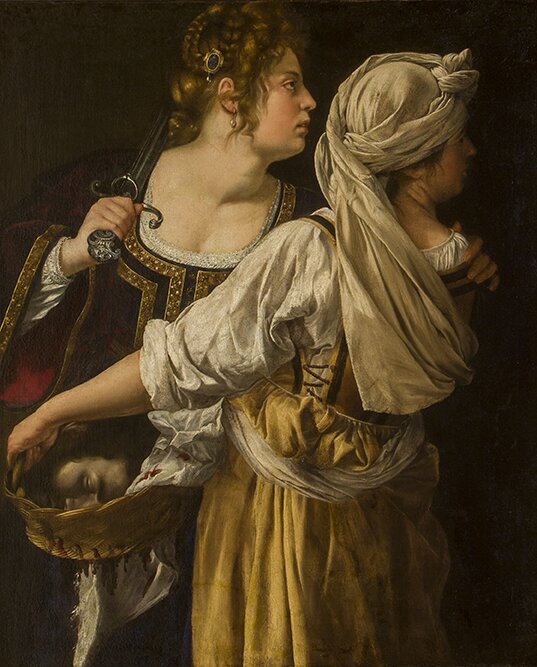
You can't miss in this life-size painting what's just taken place. Judith and her Maidservant are escaping the enemy camp where she seduced and beheaded the Assyrian general Holofernes, who'd been besieging her home city. Mind you, there's a distinct lack of blood and gore, with only the basket and cloth around the head betraying what has happened. Indeed, the elegantly dressed Judith holds up a remarkably clean and shiny sword. The action is outside the picture, as the two women look back, in some anxiety, at the scene of the assassination. Have they heard a noise? Has the alarm been sounded? Judith's hand on her servant's arm underlines the urgency of their flight, and their complicity.
This painting's from the Uffizi; alas, we don't get to see that gallery's other Judith by Artemisia, the one in which she's actually slicing Holofernes' head off, with plenty of blood, an image of such violence that it still has the power to shock. Artemisia, you see, could even out-Baroque Caravaggio. Anyway, in Paris, we have to content ourselves with a copy of Artemisia's other Judith Slaying Holofernes, from Naples.
This painting's from the Uffizi; alas, we don't get to see that gallery's other Judith by Artemisia, the one in which she's actually slicing Holofernes' head off, with plenty of blood, an image of such violence that it still has the power to shock. Artemisia, you see, could even out-Baroque Caravaggio. Anyway, in Paris, we have to content ourselves with a copy of Artemisia's other Judith Slaying Holofernes, from Naples.
Judith -- such a strong female character. It's impossible to look at Artemisia's art -- at least it is now -- without the knowledge of her personal history. In 1611, not yet 18, she was raped by the painter Agostino Tassi, a friend of her father. Tassi then promised to marry her but after nearly a year of waiting, her father filed a lawsuit against Tassi and Artemisia endured torture to prove that she was telling the truth.
Best not to overinterpret, though: Susanna and the Elders was painted a year before the rape. But it expresses so much the difficulties faced by a vulnerable woman in a world dominated by powerful men. Susanna rebuffs the sexual advances of the two old men conspiring to accuse her of adultery if she doesn't succumb. The two men gel into a threatening mass towering over her.
.jpg)
One of the first few paintings you get to see is a somewhat later work, with a rather theatrical feel. It's another Biblical story, depicting the courageous Esther, the Jewish queen of Persia, confronting her husband Ahasuerus to prevent a massacre of her people. Terrified by the gravity of her task, she faints, drawing the king's concern.
.jpg)
Unlike so often in art history, Artemisia depicts the king not as elderly, bearded and formidable, but as an elegant young man in a sumptuous outfit; just look at those boots and the puff-and-slash sleeves and breeches. He really doesn't appear the massacring type, to be honest.
Let's move on to another determined and resolute woman. This time it's Jael, from the Book of Judges. She has given refuge, food and shelter to the defeated commander of the Canaanite army, Sisera. He'd been fleeing the aftermath of a disastrous battle with the Israelites, with whom Jael's nomadic tribe was allied. Now, she's about to kill Sisera by driving a tent peg through his skull. What drama and so sumptuously depicted!
.jpg)
Artemisia's own likeness can be seen in many of her female figures, but she also painted numerous self-portraits, and these certainly served as a form of promotion. This one below dates from her time in Florence; playing the lute, an instrument of the court, it signals her as participating in the courtly and intellectual life of the city.
.jpg)
There's no doubt that Gentileschi was regarded as being in the very front rank of painters while she was alive. In Rome in 1620, the Dutch painter Leonaert Bramer produced a series of drawings of leading artists in town; Artemisia's the only woman in the group, and the only Italian, and here Bramer put her on the same level as her male counterparts such as Claude Lorrain and Gerrit van Honthorst -- by giving her a moustache....
.jpg)
Practicalities
Artemisia: Heroine of Art runs at the Musée Jacquemart-André in Paris until August 3. It's open from 1000 every day, closing at 1800 Mondays to Thursdays, 2200 on Fridays and 1900 on Saturdays and Sundays. Full-price tickets cost 18 euros and, given the crowds, it's highly advisable to book online here. We spent about 90 minutes in this exhibition, a fair proportion of it jostling for position. Note that the wall captions for individual paintings are only in French, which can be challenging when it comes to Biblical names in particular. Oh, and we should also just warn you that the space set aside for lockers for coats and bags is astoundingly cramped, too....
The museum is at 158 Boulevard Haussmann, about half-way between the Arc de Triomphe and the area with the big department stores close to Saint-Lazare station. The nearest Metro stops are Miromesnil and Saint-Philippe du Roule on lines 9 and 13.
Also on in Paris....
Perhaps no less crowded, but with a bit more room to manoeuvre, is the Suzanne Valadon retrospective at the Pompidou Centre, on until May 26, while the star attraction at the Musée d'Orsay is a fun survey of late 19th-century posters, Art Is in the Street, ending July 6.Images
Artemisia Gentileschi (1593-1653), Judith and Her Maidservant, c. 1615, Gallerie degli Uffizi, Galleria Palatina, Florence. Image: Su concessionne del Ministera della Cultura
Artemisia Gentileschi, Susanna and the Elders, 1610, Kunstsammlungen Graf von Schönborn, Pommersfelden, Bavaria. Photo: akg-images/MPortfolio
Artemisia Gentileschi, Esther before Ahasuerus, c. 1628, The Metropolitan Museum of Art, New York. Courtesy of the Metropolitan Museum of Art
Artemisia Gentileschi, Jael and Sisera, 1620, Szépművészeti Múzeum/Museum of Fine Arts, Budapest. Photo: Szépművészeti Múzeum/Museum of Fine Arts, Budapest, 2025
Artemisia Gentileschi, Portrait as a Lute Player, 1614-15, Wadsworth Atheneum Museum of Art, Hartford, Connecticut. Photo: Allen Phillips/Wadsworth Atheneum
Artemisia Gentileschi, Susanna and the Elders, 1610, Kunstsammlungen Graf von Schönborn, Pommersfelden, Bavaria. Photo: akg-images/MPortfolio
Artemisia Gentileschi, Esther before Ahasuerus, c. 1628, The Metropolitan Museum of Art, New York. Courtesy of the Metropolitan Museum of Art
Artemisia Gentileschi, Jael and Sisera, 1620, Szépművészeti Múzeum/Museum of Fine Arts, Budapest. Photo: Szépművészeti Múzeum/Museum of Fine Arts, Budapest, 2025
Artemisia Gentileschi, Portrait as a Lute Player, 1614-15, Wadsworth Atheneum Museum of Art, Hartford, Connecticut. Photo: Allen Phillips/Wadsworth Atheneum
Leonaert Bramer (1596-1674), 1620, Portrait of Artemisia Gentileschi as a Man with a Moustache, Musées royaux des Beaux-Arts de Belgique, Brussels
Comments
Post a Comment