What a lot of new exhibitions this October! We list well over 20 across Europe below -- many more than usual -- and have still had to leave out quite a few that we'd mention in most other months in order to keep this post to a reasonable length. Let's start at the Royal Academy in London with deep blue seas, cloudless skies, intense light and the heat of the sun. From October 2 to January 31, you can experience the excitement Renoir, Cezanne, Matisse, Picasso and many others felt while Painting the French Riviera . The exhibition features more than 160 exhibits from the 1870s to the 1960s, and a version of the show travels on to the Cleveland Museum of Art in March. Hmm, Renoir. Now perhaps seen as the most chocolate-boxy of the Impressionists, but without doubt the creator of some of the most recognisable images in French art of the late 19th century. Well worth stealing , and clearly the National Gallery is on to a winner with its Renoir and Love ex...

Just before Christmas, we discovered Cyril Mann's astonishing Solid Shadow Paintings at Piano Nobile in west London. So the chance to see the wider range of this forgotten British artist's work at The Lightbox in Woking -- an impressive venue we'd never visited before -- wasn't one we were going to pass up.
Cyril Mann: Painter of Light and Shadow seeks to tell the story of a troubled artist who embraced a variety of styles during his career. Born in London in 1911, Mann grew up in Nottingham and became the youngest ever recipient of a scholarship to the Nottingham School of Art at the age of 12. He spent time in Canada before returning to study at the Royal Academy and then went to Paris to train under the Scottish Colourist JD Fergusson, painter of that bacchanalian extravaganza Les eus.
Mann was always interested in the effects of sunlight and shadow, and among the exhibits in this show is a notebook from 1937 recording his observations. The shadow side of the equation is most obvious in his solid-shadow pictures from the 1950s, three of which are on display in Woking, including Still Life with Pot Plant and Oranges, a typical example of a genre in which he explored the veil-like shade cast by electric light in his gloomy flat in Islington.
What a contrast, then, with a selection of paintings from Paris and London before and after World War II lit by a dazzling sun. This is Finsbury Square, on the edge of the City of London, in about 1948. And what a sun it is. Even that bright red trolleybus can't compete.
 In Wilson Street, EC2, the sun is breaking through onto a rain-drenched street just behind Finsbury Square. Mann clearly didn't tend to venture far in search of his motifs.
The earliest picture in this show was painted when he was just 14, and a student in Nottingham. It's a rather unsettling image, with a touch of the surreal about it. There's a picnic going on in the sunlit foreground of Dark Satanic Mills, but behind all is grey, overshadowed by the factory belching out plumes of smoke.
 My Earliest Self-Portrait was made when the artist was in his mid-20s. There's a slightly haunted look in those eyes. Later in his career, Mann struggled to achieve the recognition he felt he deserved. He suffered lengthy spells of illness and spent time in mental hospitals.
 Mann's happiest period looks to have been in the 1960s, when his Dutch-Indonesian second wife, Renske, seen on the left of the exhibition view below, was his model and his muse. His pictures from this period are much lighter, more sketchy, but rather less distinctive than the solid-shadow works to be seen on the right.


Cyril Mann: Painter of Light and Shadow seeks to tell the story of a troubled artist who embraced a variety of styles during his career. Born in London in 1911, Mann grew up in Nottingham and became the youngest ever recipient of a scholarship to the Nottingham School of Art at the age of 12. He spent time in Canada before returning to study at the Royal Academy and then went to Paris to train under the Scottish Colourist JD Fergusson, painter of that bacchanalian extravaganza Les eus.
Mann was always interested in the effects of sunlight and shadow, and among the exhibits in this show is a notebook from 1937 recording his observations. The shadow side of the equation is most obvious in his solid-shadow pictures from the 1950s, three of which are on display in Woking, including Still Life with Pot Plant and Oranges, a typical example of a genre in which he explored the veil-like shade cast by electric light in his gloomy flat in Islington.
What a contrast, then, with a selection of paintings from Paris and London before and after World War II lit by a dazzling sun. This is Finsbury Square, on the edge of the City of London, in about 1948. And what a sun it is. Even that bright red trolleybus can't compete.

The earliest picture in this show was painted when he was just 14, and a student in Nottingham. It's a rather unsettling image, with a touch of the surreal about it. There's a picnic going on in the sunlit foreground of Dark Satanic Mills, but behind all is grey, overshadowed by the factory belching out plumes of smoke.


Self-Portrait (with Double Nude), from the mid-60s with its painting within a painting is the most ambitious of the works in Woking, and the most expensive, should you be moved to acquire a Cyril Mann. Like much of his work from this period, the light is much more important than the subject matter.

Actually, many of the paintings we preferred aren't available for sale, including the unexpected delight of a Railway Bridge over the Culvert, Walthamstow, as if one of the Impressionists had resurfaced in a grotty part of East London a century on and sparkled a little bit of magic over it.
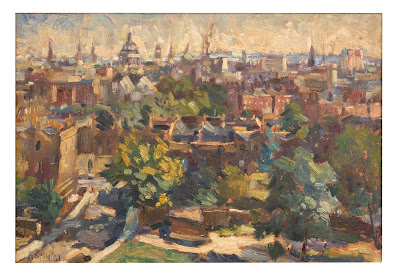
The natural light returned to Mann's work late in the 1950s when the local council moved him out of his gloomy flat near Old Street and into much brighter accommodation into the very modern Bevin Court development, with a view to the dome of St Paul's and out across the City and beyond.

This is a small and well put-together exhibition, though we'd have liked to have seen a few more of the solid-shadow paintings, the most striking part of Mann's oeuvre. Was he the unsung hero of British painting in the 20th century? Decide for yourself in Woking.
Practicalities
Cyril Mann: Painter of Light and Shadow can be seen at The Lightbox in Woking until March 31. It's open Tuesday to Saturday 1030-1700, with lates on Thursday to 2030, and on Sunday from 1100 to 1600. A day pass to the gallery's exhibitions costs £5, or you can buy an annual pass for £7.50, which we think is a bit of a bargain. The Lightbox is a five-minute walk from Woking station, which has frequent trains from London Waterloo taking about 25 minutes.
Images
Cyril Mann, Finsbury Square, c. 1948. © The Artist's Estate courtesy of Piano Nobile
Cyril Mann, Dark Satanic Mills, 1925. © The Artist's Estate courtesy of Piano Nobile
Cyril Mann, My Earliest Self-Portrait, c. 1937. © The Artist's Estate courtesy of Piano Nobile
View of the exhibition. © The Lightbox, Woking
Cyril Mann, Self-Portrait (with Double Nude), 1965. © The Artist's Estate courtesy of Piano Nobile
Cyril Mann, St Paul from Bevin Court, 1961. © The Artist's Estate courtesy of Piano Nobile
Comments
Post a Comment